How to Choose the Right EMS Partner in India: 2026 Guide
Quick Answer: To choose the right EMS partner in India, evaluate seven factors: certifications (ISO 9001, IATF 16949 for automotive), manufacturing capacity and equipment, DFM support, prototype capability, quality processes, supply chain reliability, and cultural fit for long-term partnership. A wrong choice at this stage costs far more in delays and rework than the time spent evaluating properly.
You've finalised your PCB design. Your BOM is ready. Now comes the decision that will determine whether your product ships on time, at cost, and at the quality your customers expect — choosing the right Electronics Manufacturing Services (EMS) partner.
India has hundreds of contract manufacturers offering PCB assembly, box build, and full turnkey services — from large listed companies to small shops operating out of industrial estates. The range is wide. The quality is not consistent.
The two most common mistakes when selecting an EMS partner: going with whoever is cheapest, or going with whoever responds fastest. Neither tells you anything about whether they can actually deliver.
This guide breaks down exactly what to look for — and what to watch out for — when choosing an EMS partner in India.
What We Cover
1. Start With Certifications — But Read Beyond the Badge
Certifications are the baseline, not the differentiator. Every credible EMS company in India will have ISO 9001:2015. That's table stakes. What matters is which additional certifications they hold and whether those align with your product's requirements.
ISO 9001:2015 — General quality management. Required for any serious EMS partner.
IATF 16949:2016 — The automotive quality standard. If your product goes into a vehicle — including EV components, instrument clusters, or automotive sensors — your EMS partner must hold this certification. Without it, you cannot qualify on most OEM approved vendor lists. Look for certification by a recognised body like TÜV Rheinland, not an obscure local certifier.
AS9100D — The aerospace and defence equivalent of IATF 16949. Built on ISO 9001 but adds aviation, space, and defence-specific requirements. If your product touches defence or aerospace applications, this is non-negotiable.
ISO 14001 / ISO 45001 — Environmental management and occupational health. These signal a mature, audit-ready operation. Companies that maintain these alongside their core manufacturing certifications tend to run tighter processes overall.
IPC-A-610 — The global standard for acceptability of electronic assemblies. Ask whether the facility has IPC-certified trainers on-site, not just externally audited. An in-house IPC trainer means standards are embedded in daily operations, not just pulled out during audits.
One thing to verify: certifications must be current and issued by an accredited body. Ask for the certificate and check the validity date. Lapsed certifications are more common than you'd expect.
2. Evaluate Manufacturing Capacity Against Your Volume Needs
Choosing an EMS partner whose capacity matches your volume is harder than it sounds. Large manufacturers aren't interested in small-batch or prototype work. Small assemblers don't have the equipment for mid-to-high volume production.
Key numbers to ask for:
SMT line capacity in CPH (components per hour) — This tells you how many components per hour their pick-and-place machines can handle. A facility with three SMT lines and a combined 200,000+ CPH can handle meaningful volume.
Daily board output — For wave soldering, ask specifically. A facility capable of 6,000 boards per day (100mm length) on its wave line is a different league from a small shop doing 500.
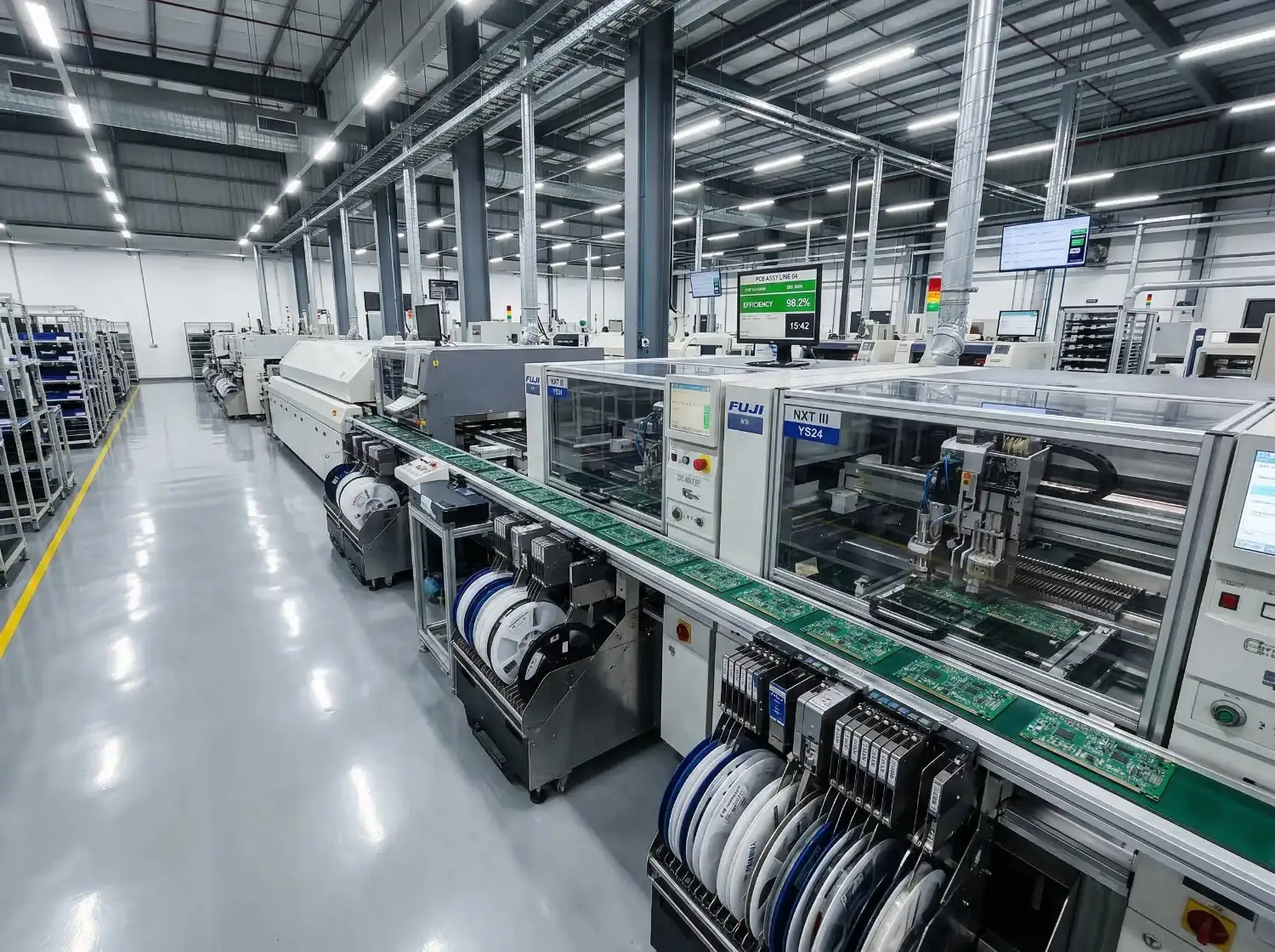
Number of dedicated SMT lines and their configuration — Siemens, Fuji, and Panasonic lines are industry-standard. Older equipment with no AOI (Automated Optical Inspection) at the end of each line is a red flag.
Plant layout — A dedicated facility with separate zones for PCBA and box build is more mature than a single-floor generalist shop.
Also ask whether they have a dedicated prototype line. Prototype builds require different setups, smaller batches, and faster changeovers. If a manufacturer runs prototypes on the same line as production, your prototype will always get deprioritised when a large production run comes in.
3. Assess Their Component Assembly Capabilities
The equipment list on a manufacturer's website and what they actually run reliably day-to-day are often two different things. For IoT and automotive designs specifically, here's what to verify directly.
For modern IoT and automotive designs, you need to confirm:
Fine-pitch SMD capability — Components down to 0201 (0.6mm x 0.3mm) are now common in IoT modules. Your EMS partner needs the placement machines and inspection equipment to handle these reliably.
BGA and LGA assembly — Ball Grid Array and Land Grid Array components are standard in high-density designs. Ask whether they have X-ray inspection equipment to verify BGA solder joints, which are invisible to optical inspection.
CSP (Chip Scale Package) placement — Relevant for miniaturised designs.
Through-hole (PTH/THT) capability — Many modern boards still have through-hole connectors or capacitors. A facility that only does SMT is not a full-service EMS partner.
Conformal coating — If your product goes into harsh environments (automotive, industrial, outdoor IoT), selective conformal coating is essential. Not every EMS company has this capability in-house.
For IoT module manufacturing specifically, also ask about tape-and-reel capability and vacuum sealing for moisture-sensitive (MSL) components. Most buyers don't ask about these until a batch fails. Ask upfront.
4. DFM Support: The Differentiator That Saves You Money
Design for Manufacturability (DFM) is where a good EMS partner pays for itself — often before manufacturing even begins.
DFM is the process of reviewing your PCB design and flagging issues that will cause manufacturing problems, increase cost, or reduce yield. A proactive EMS partner will provide DFM guidelines upfront, before your design is finalised. A reactive one will wait until the board fails on the line and then tell you what went wrong.
Questions to ask:
- Do they provide DFM guidelines before you submit your Gerber files?
- Do they flag pad size issues, insufficient solder mask clearance, or component placement conflicts as part of their onboarding?
- Do they have engineering staff dedicated to new product introduction (NPI), or does your design go straight to the production floor?
The answer to these questions tells you whether you're working with a manufacturing partner or a job shop. A manufacturing partner protects you from expensive respins. A job shop builds whatever you give them and sends you the failure report.
5. Quality Process: What Happens When Something Goes Wrong
Quality control is the easiest thing to claim and the hardest thing to verify from a brochure. The right question isn't "do you have quality processes" — it's "what happens when a batch fails."
In-process inspection at multiple stages — A mature quality process has inspection checkpoints at incoming materials, post-solder paste printing, post-reflow (AOI), and final inspection before dispatch. A process that only inspects at the end is catching problems too late.
First Pass Yield (FPY) data — Ask for their FPY numbers. High first-pass yield means less rework, faster throughput, and fewer quality escapes reaching you. Any credible EMS partner should be able to share this.
Rework process — Ask how they handle boards that fail inspection. Do they rework in-house? Do they have BGA rework capability? A facility with a dedicated BGA rework station (ZM-R7220A or equivalent) is better equipped to recover expensive boards than one that scraps failures.
Six Sigma and lean practices — Tools like 5S, KAIZEN, FMEA, SPC, and Six Sigma mean something when they're embedded in daily operations. Ask what their defect rate is and how they track it. If they can't answer with a number, they're not measuring it.
Periodic audits — Ask whether they conduct internal audits and Small Group Activities (SGAs) for continuous improvement, or whether audits only happen when a customer or certifier asks for them.
6. Supply Chain Reliability: The Hidden Risk
Component shortages in recent years exposed a vulnerability most hardware companies didn't know they had — their EMS partner's supply chain. When lead times stretched to 52 weeks, companies whose manufacturers had strong sourcing infrastructure survived with far less disruption.
In 2025, the lesson holds. Evaluate:
- Sourcing relationships — Does your EMS partner have established distribution relationships for both active components and passives? A partner with direct relationships in China and Taiwan-sourced components will navigate shortages better than one buying spot market.
- Component lead time visibility — Can they give you realistic lead time estimates for your BOM at the time of quoting, not after you've committed?
- ERP system — An EMS company running on spreadsheets for material management is a risk. Ask whether they run an integrated ERP system for material tracking and production planning — and whether it's actually live, not being implemented.
- Low inventory with high turns — Counter-intuitively, a well-run EMS facility doesn't warehouse huge component stocks. They use lean inventory practices with high turns, which means fresher components and lower risk of obsolescence.
Overall lead time for a typical build — from customer order to dispatch — should be in the range of 30–35 days for a well-run operation. If a partner quotes 60+ days without a clear supply chain reason, ask why.
7. Cultural Fit and Communication: What Doesn't Show Up in the Checklist
Every item on this list can be faked in a sales meeting. Cultural fit is the one thing that's harder to fake — and it usually shows up in the first conversation.
A good EMS partner treats your product like their own. They ask questions about end-use environment, field failure risk, and testing requirements — not just board specifications. They flag concerns before they become problems. They answer calls and respond to emails within a reasonable window.
Signs of a good cultural fit:
- They give you a facility tour without hesitation
- They can reference the industries and product types they've built for before
- Their team has depth — people who've worked at recognisable OEMs and know what real quality looks like from the customer side
- They tell you upfront if your design has something they haven't built before, rather than discovering it mid-production.
Signs to be cautious about:
- Vague answers about certifications or capacity
- Resistance to sharing process documentation or audit results
- Quoting suspiciously low without a clear explanation
- No dedicated engineering point of contact — just a sales person
A Note on Bangalore as an EMS Hub
For hardware companies based in South India — or those looking to source closer to design hubs — Bangalore has particular advantages. The city sits at the intersection of electronics design, IT, and manufacturing, which means a concentration of component distributors, contract manufacturers, and engineering talent that few other Indian cities can match.
Location matters operationally too. A facility positioned near key logistics corridors can move materials faster and dispatch finished goods more reliably. Proximity to your design team also matters for prototype iterations, where physical visits to review a board failure or approve a first article are often faster and cheaper than shipping samples back and forth.
Summary: The 7-Point EMS Partner Checklist
Before shortlisting any EMS partner in India, validate these seven points:
- Certifications — ISO 9001:2015 minimum; IATF 16949:2016 if automotive; issued by an accredited body and currently valid
- Capacity — SMT CPH, daily output, number of lines, AOI on each line
- Assembly capability — Fine pitch, BGA/LGA, X-ray, conformal coating, THT
- DFM support — Proactive guidelines before design freeze, dedicated NPI engineering
- Quality process — Multi-stage inspection, FPY data, Six Sigma practices, BGA rework capability
- Supply chain — Established distributor relationships, ERP system, lean inventory
- Cultural fit — Communication quality, transparency, industry experience, willingness to visit
Frequently Asked Questions
What is the difference between EMS and ODM?
An EMS (Electronics Manufacturing Services) company manufactures products based on your design. An ODM (Original Design Manufacturer) both designs and manufactures. For hardware companies with their own IP, EMS is the right model.
Do I need IATF 16949 certification if my product is not automotive?
Not necessarily, but it is a strong quality signal regardless of industry. Companies that maintain IATF 16949 typically have more rigorous process controls than those that only hold ISO 9001.
How do I evaluate an EMS partner before visiting?
Start with their certifications (ask for copies), their client references (ask for industries served, not just names), and their capability list. A video call tour of the facility is a reasonable first step before committing to a physical visit.
What questions should I ask on a first facility visit?
Ask to see the production floor during an active run, not an idle period. Ask for their most recent internal audit report. Ask how they handled their last quality escape. The answers to these questions tell you more than any brochure.
How important is location for an EMS partner?
More than most people realise. Proximity reduces logistics cost and lead time for prototypes, and allows you to visit quickly when there is a quality issue. For companies in Bangalore and South India, choosing an EMS partner in the same city has practical advantages over a facility in another state.
Vishesh Innovative Technologies (VIT) is a Bangalore-based EMS company certified to ISO 9001:2015 and IATF 16949:2016 (TÜV Rheinland), ISO 14001:2015 and ISO 45001:2018 (TÜV NORD), and AS9100D. Established in 2013, VIT operates a 45,000 sq ft facility with three SMT lines and serves customers across IoT, automotive/EV, defence, and power infrastructure. Contact us to discuss your manufacturing requirements or schedule a facility visit.

